

By the BioMirco team. Written and fact-checked against NHS, NICE, EFSA and peer-reviewed sources.
|
KEY TAKEAWAYS
|
The fertility supplement aisle is full of big promises. Knowing how to read past them, and what the science actually says, helps you choose wisely. Here is what fertility supplements can and cannot do.
Do fertility supplements work?
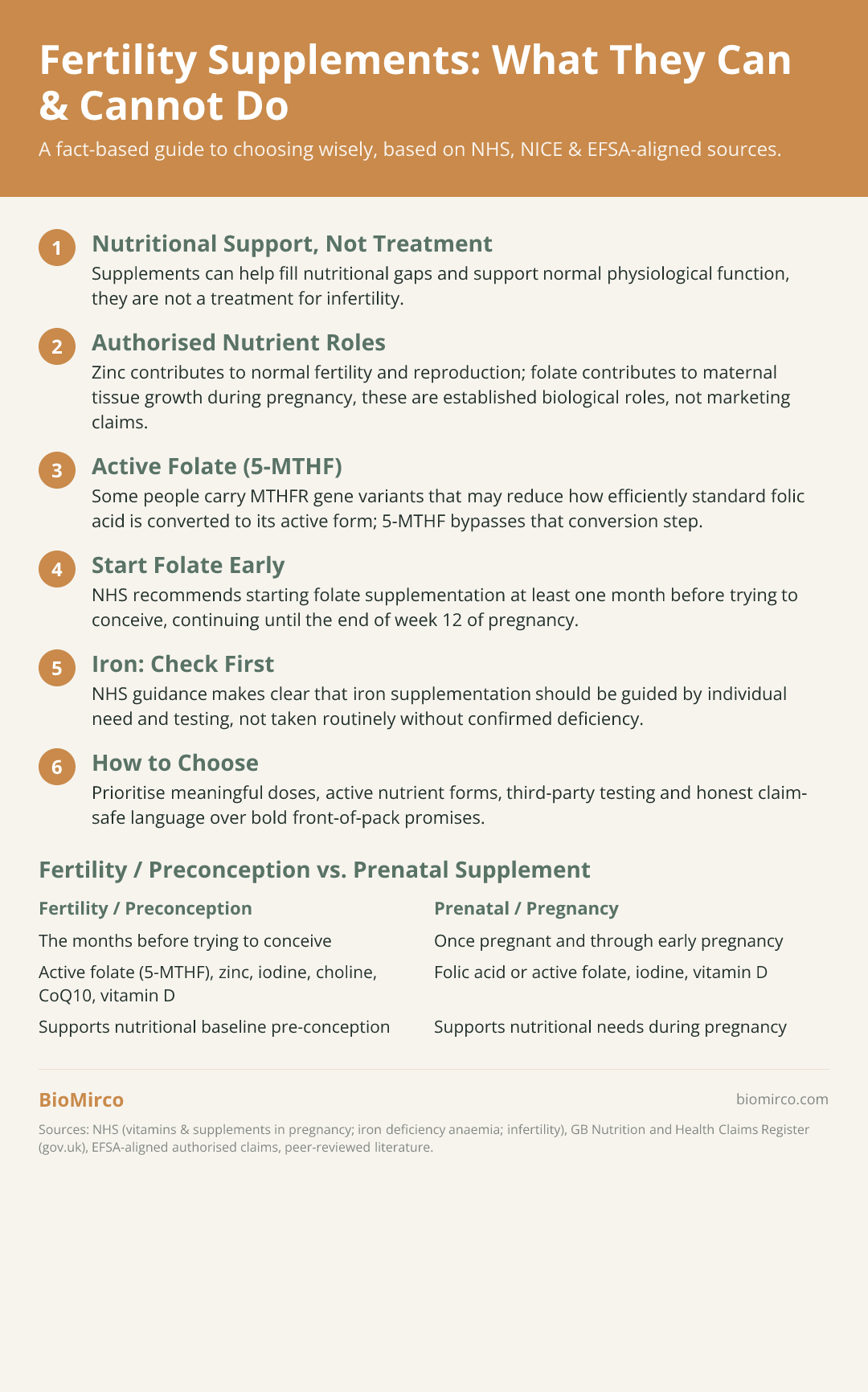
They can help fill nutritional gaps and support normal physiological function, but they are not a treatment for infertility. NHS guidance on vitamins and supplements in pregnancy frames them as nutritional support, not medical intervention.
What can a fertility supplement actually do?
A well-formulated supplement can deliver nutrients with authorised biological roles, as listed on the GB Nutrition and Health Claims Register. Folate contributes to maternal tissue growth during pregnancy, and zinc contributes to normal fertility and reproduction. These are established nutrient functions, not marketing claims.
Some formulations also include coenzyme Q10 (CoQ10). Some research has explored its role in ovarian response, and it is included in certain preconception supplements on that basis. No authorised health claim exists for CoQ10 under the GB Register, so it should be considered a factual ingredient inclusion rather than a guaranteed benefit. Findings from individual trials are specific to the populations studied and should be read with appropriate caution.
What can a fertility supplement not do?
Guaranteed pregnancy outcomes are beyond the reach of any supplement. Medical causes of infertility, such as blocked fallopian tubes or significantly impaired sperm function, require investigation and treatment by a qualified clinician. A supplement supports your nutritional baseline. Any product implying otherwise is overpromising, and honest formulation communication matters far more than bold marketing claims.
Fertility supplement or prenatal: which do you need?
The two categories overlap but serve slightly different purposes. Here is a practical comparison:
| Type | Best for | Key nutrients to look for |
|---|---|---|
| Prenatal / pregnancy | Once pregnant and through early pregnancy | Folic acid or active folate, iodine, vitamin D |
| Fertility / preconception (women) | The months before trying to conceive | Active folate (5-MTHF), zinc, iodine, choline, CoQ10, vitamin D |
| Fertility / preconception (men) | The months before trying to conceive | Zinc (contributes to normal fertility and reproduction), selenium (contributes to normal spermatogenesis), vitamin C, vitamin D, CoQ10 |
BioMirco Fertility Advance is a preconception formulation for women, providing active folate, zinc, iodine, choline and vitamin D in carefully selected nutrient forms.
Two ingredients worth understanding in more detail are choline and iron, as both are often included in preconception or prenatal formulations but are not always clearly explained on pack.
| Ingredient | Why it is included | What to know |
|---|---|---|
| Choline | Plays a role in normal cell function and is important during early foetal development, particularly for neural tube closure alongside folate. | Choline does not currently hold an authorised preconception claim under the GB Register. It is described in terms of its established nutritional role rather than as a fertility nutrient. |
| Iron | Sometimes included in prenatal supplements to support normal red blood cell formation. | Supplemental iron is not universally recommended without a confirmed deficiency. NHS guidance on iron deficiency makes clear that iron supplementation should be guided by individual need and testing. Speak with your GP before supplementing. |
Why active folate (5-MTHF) may be worth considering
Most people know to take folic acid before pregnancy. The NHS recommends starting folate supplementation at least one month before trying to conceive, and continuing until the end of week 12 of pregnancy. What is less widely known is that some people carry a genetic variation in the MTHFR gene that can affect how efficiently the body converts standard folic acid into its usable form.
Some people carry MTHFR gene variants that may reduce how efficiently standard folic acid is converted to its active form. This is a well-recognised area of folate biology. For those with impaired conversion, the active form, 5-methyltetrahydrofolate (5-MTHF), bypasses the conversion step and is used directly by the body.
BioMirco formulations use active folate rather than standard folic acid, which means the nutrient is provided in a form that does not rely on that conversion step. Folate carries an authorised claim that it contributes to maternal tissue growth during pregnancy and to normal cell division.
How do you choose a good fertility supplement?
Look past the front-of-pack messaging and check the detail. A thorough fertility supplement ingredient checklist can help you compare products systematically. In general, prioritise:
- Doses that are meaningful relative to reference intakes, not token amounts included for label value.
- Active nutrient forms, such as 5-MTHF folate rather than standard folic acid.
- Third-party testing and transparent manufacturing standards.
- Honest, claim-safe language that describes what nutrients do, not what the product promises to achieve.
Frequently asked questions
Are fertility supplements a waste of money?
Not if your nutritional intake has gaps. They support your baseline nutrition. What they cannot do is guarantee a particular outcome, and any brand that suggests otherwise deserves scrutiny.
Can a supplement replace IVF or medical treatment?
No. Nutritional support sits alongside medical care, not in place of it. If you have concerns about your fertility, speaking with a GP or fertility specialist is a sensible first step.
What is the most important nutrient to start with?
Active folate is typically the priority for women planning to conceive. BioMirco preconception formulations use the active 5-MTHF form, which does not rely on the folic acid conversion step.
Sources
NHS: vitamins, minerals and supplements in pregnancy
GB Nutrition and Health Claims Register, gov.uk
This article is for general information and education only. It is not medical advice. Nutrient claims refer to authorised biological roles of nutrients, not to guaranteed outcomes. If you have concerns about your fertility or nutritional status, please speak with a qualified healthcare professional.